Social media has changed the way employees in organizations
work, learn, communicate and collaborate. According to Accenture, companies
that invested early to harness the power of social media claim returns as high
as 20 to 1, with even greater gains predicted to be on the way and the reality
is that its impact will be felt along the entire length of the value chain. Employees,
who are also users of public social media sites, were looking for tools to increase
their productivity through collaboration across globally dispersed workforce. Collaboration 2.0 is a suite of tools that include blogs,
wikis, and youtube, facebook style social media tools that employees can use to
do their jobs in a better way and strengthen client relationships. Through
these tools 236,000 employees of Accenture located in 120 countries collaborate
for organizational growth and Collaboration 2.0 improved team productivity,
reduced travel and phone charges via a new world of virtual collaboration and
strengthened client relationships. In 2008 Accenture launched collaboration
initiative called “Borderless Workplace” which includes technologies a
wiki called Accenture Encyclopedia, Accenture media exchange resembling YouTube,
personal blogs for employees and a facebook inspired social network called
Accenture people, Accenture’s Knowledge Exchange is
the place to go to find the information Accenture people need.
Accenture deployed in 2007, Accenture People that is a Facebook-inspired
professional/social network that enables employees to collaborate, share
knowledge, find SMEs and instantly connect via email, online chat, whiteboard
session, high definition telepresence videoconference, phone or voicemail. Each profile is populated with standard company information
and Accenture employees are encouraged to expand their profiles and 115,000 employees have updated their profiles and 5000
profiles update every month where employees share pictures, bios, expertise, work-related
interests personal interests, hobbies and other optional personal information.
According to Accenture, as employees share more about
themselves on their profiles, the connections for prospective teams and
colleagues become richer. From a profile, an employee can get to know
coworkers, their reporting relationships and experience. Employees can use a
colleague-tracker to receive alerts when associates change information on their
profile – such as their skills or clients. Company also developed a
Wikipedia-style site called Accenture Encyclopedia, to catalogue Accenture
business and technical terminology. Close to 1000 entries posted in this
encyclopedia.
More than 1,700 Accenture Groups, communities created and
run by Accenture employees which enable them to share knowledge beyond their
job responsibilities. Group topics span from Java programming to Lean Six Sigma
to digital photography. These groups focus on an individual’s needs and
interests, as well as the needs of the communities. For microblogging Accenture
uses Yammer where teams can securely and quickly connect, Twitter-style, to
trade ideas and get the best thinking from their global colleagues. Presently
employees post more than 4200 microblog updates monthly.
Blogging capabilities amplify opportunities for sharing
experience and expertise. Accenture employees
created 10,706 blogs annually, increasing at a rate of more than 200 percent
annually. Presently employees post 1000 blog posts a month. Blogs are an
informal communications across Accenture as employees recognize the value and
power of blogs that can be easily aggregated and tagged. Employees can use this
space to post comments on strategies under development, answers to frequently
asked questions, etc. Blogs feature thought leadership on a wide range of
business issues, with a particular focus on helping companies achieve high
performance and also discuss about emerging technologies and career experiences
of select employees.
Accenture Media Exchange is a You-Tube-type tool that
included videos related to training, marketing, knowledge transition and
community-building videos circulating among employees. Currently 12,000 video
items posted to Accenture Media Exchange. Videos posted include included
executive interviews, project team presentations, and humorous snippets, and
came from users around the world. Video content
posted on the site typically is viewed by hundreds or even thousands of
colleagues within a few days. Viewers can rate and comment on the posted
content as well as download material useful for other applications.
According to Accenture, the knowledge base of Accenture’s
employees is a massive resource and a critical asset and includes discussion
forums, blogs, wikis and even ratings, comments, cross-search downloads and
recommendation functionality. The existing knowledge repository, called
Knowledge Exchange, was migrated to global Microsoft platform and consolidated
its knowledge assets into a central repository based on Microsoft SharePoint Portal
Server. The development of a new Knowledge Exchange application enabled
Accenture to retire over 40 databases and offer a single point of access
through the Accenture Portal (the company’s employee portal). Accenture's
use of NewsGator as a micro-blogging tool in the Microsoft SharePoint platform
brings a geographically dispersed workforce together to meet clients' needs.
Consolidating the knowledge assets resulted in the
enterprise search engine to index the content thoroughly and with a consistent
taxonomy applied and IT team was able to fully index the actual content of all
documents so searches would yield more relevant results. Now, Accenture
employees can search a broader range of knowledge assets from a single point of
access, or search deeply within an attachment. Today, the search engine indexes
approximately 115,000 attachments and topic pages in the Knowledge Exchange.
Accenture-wide, employees can also search across almost four million pages or
attachments from 46 different Accenture content sources, enabling efficient
searches that yield highly relevant results. Accenture Knowledge Exchange
Activity Feeds includes RSS-like activity feeds to notify employees when
articles are published, capture project status updates, display tasks and
suggest related documents.
Accenture is working on more sophisticated ways to bring
social media into the workplace and recent trends in social media and mobile
technology have created new challenges and forced Accenture to reevaluate the
IT infrastructure it has in place. Accenture has also focused on measurement
strategy and on understanding what tools employees were using, and how and why
they were using them. Monthly Collaboration 2.0 scorecard and other reports
help Accenture continuously track usage, cost savings, employee satisfaction
and impact on the clients. According to company website, cost benefits for the
company included More than 20 million minutes of company-standard monthly VoIP
audio/video usage, resulting in avoided mobile and landline long
distance/international voice costs, more than 5,000 annual video conferencing
meetings resulting in avoided travel costs and Telepresence usage has slashed
travel costs and the savings are exceeding the annual targets, thus far
returning more than two times the monthly operating cost.
According to Accenture, they even made these tools
available to their FORTUNE 500 clients, bringing clients into their
collaborative culture. Links between Accenture and client companies include Telepresence,
desktop audio and video, secure IM, desktop-sharing and unified messaging that
dramatically improves dialogue with clients. Collaboration 2.0 has
significantly improved client satisfaction levels and clients are being
services well with right skilled consultants at right time for the critical
projects and reaction time to client’s requests have also improved. Employees
too are satisfied with this collaboration suite as they are able to collaborate
seamlessly with their colleagues across the globe, share their knowledge,
interact with SMEs and voice their opinions regarding the company policies and
strategies. Accenture is one of the best examples for understanding the
business impact of integrating social media tools into the organization.
Discussion
points:
- What are the key lessons
of the Accenture Social Media Strategy and how it improved profitability?
- What is the role played
by Collaboration 2.0 in improving the employee satisfaction and how to
encourage employees to utilize this best?
- How did clients of
Accenture profit from its internal social media tools?
- What is the role played
by social media tools in organizational Knowledge management strategy?
Appendix:
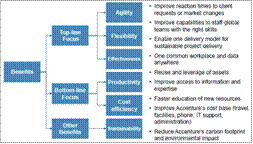
Figure 1: Collaboration benefits outlined
in Accenture's business case. Copyright 2010 Accenture