Showing posts with label Blogs. Show all posts

Sunday, October 20, 2013

Social Media Marketing Strategy Case Study – Intel Inc. presence on Facebook, YouTube

Intel was one of the first companies that adopted social media, actively present on major social media platforms like Blogs, Facebook, Twitter, YouTube, etc. and also uses social network styled platforms both internally to engage with employees and externally to engage with community. The company currently has 75 Intel-related accounts with nearly 180,000 followers. The company has 19 different topical or regional blogs. The company has 11 communities in several different languages plus software community for developers. Intel’s Facebook presence comprises 50 Facebook Fan Pages in different countries, led by Facebook.com/Intel, which has 1.5 million fans, plus a YouTube Intel Channel. The company is everywhere - blogs, Facebook (close to 23 million likes, close to 400,000 people are talking about the company on Facebook), Twitter (close to 2.2 million followers, more than 400 tweets and more than 1,150 followers!), YouTube (2 channels, close to 5,000 videos, more than 45 million video views and close to 63,000 subscribers!), Instagram (more than 200 posts and close to 6,000 followers), Google+, LinkedIn, etc. Intel Free Press is a tech news site from Intel Corporation, covering technology and innovation stories focused on people, technology, events and topics relevant to Intel and the computing industry.

Under Intel’s global social media strategist, Ekaterina Walter leadership, Intel has seen a good 10% to 12% monthly fan base growth. Her principles for Facebook engagement include original content, not just automated, and original videos, not just YouTube links. In August 2012, Intel’s campaign “How computers were made” post on Facebook attracted 102,5K+ likes in a week since it was published on August 9. More than 34,069 people have chosen to share the link, while 3,258 commented on it. 80%, of the conversations around Intel and products happen on blogs and twitter. Facebook usage within the business has also increased with 250 individually created and managed pages which was becoming difficult to co-ordinate and manage multi market campaigns. After reviewing 250 Facebook pages  and 250 Twitter handles/account  presence,  Intel took the decision to alter their social media strategy from being decentralized to a centralized global strategy supported by internal guidelines, training programs, content editorial, publishing schedules, supplemented by a suite of publishing Vitrue, listening, Radian6, & internal reporting tools. This centralized strategy allows them to listen and respond globally, locally or to individuals, based on the context of the conversation.

Intel’s marketing is not just about hardware, chips and engineering--“experience” is the new focus.  "People don’t buy processors…they buy experiences," said David Veneski U.S. Media Director, at Intel Corporation. “You need to turn a moment into a momentum, and a momentum into a movement,” Veneski said. Projects like Intel’s Museum of Me use social media to encourage users to create a “visual archive of their social life.” Another campaign, “Intel Ultrabook Temptations” is a collaborative social experiment to assess how desperate people will be to get their hands on the product. In this experiment users are encouraged to jump around on a custom-built measurement device to generate their “excitement” rating and the event is captured on video and shared socially as the feature on Intel’s YouTube page.

“The focus has shifted from being iconic to posting a status update," said Veneski which makes Intel more humanized and relatable to the consumer. Intel is embracing social media and using it as a key element to understand the driving factors behind day-to-day experiences. Intel’s products are at the core of technologies that people use, and users like to capture those experiences, talk about them, and share them with friends, families and others. Through blogs, video, and social networks like Twitter, Intel is actively onboarding new customers’ faster and strengthening relationships with existing customers. Like most companies, the online community was initially built by marketing. "It is integrated into our marketing plan," explains Laurie Buczek, who heads enterprise marketing for Intel's Storage Group and works closely with the leaders of Intel's 3,000 to 4,000 salespeople. Intel also uses YouTube, which enables product managers to vividly demonstrate new technologies and Twitter (@Intel). Intel’s Social Media Center of Excellence sets the strategy and guidelines for all social media content across the company’s far-reaching locations and business units. 

Sunday, July 29, 2012

Social Media @ Intel – Planet Blue internal social network for Employees


Intel, the world's largest and highest valued semiconductor chip maker, based on revenue has an internal social media platform called Planet Blue that was launched in 2009, which is company controlled Facebook styled intranet, where more than 1,00,000 employees can connect with each other, collaborate and share knowledge. Planet blue includes blogs, wikis, status updates, discussion forums and employees can also form groups based on their interests, hobbies, etc. Employees not only communicate and create groups but also use the platform to ideate and innovate which is essential for Intel as there is constant pressure on the company to develop new products. Intel earlier had a wiki based platform for collaboration, called Intelpedia, "the Intel encyclopedia that anyone can edit," was launched in 2006, which employees can edit freely  and had millions of pages and thousands of contributors. Intel had a culture of technology-based information-sharing since early 2003, when employee blogging started predominantly included self-maintained servers under desks and these internal employee blogs gained popularity. Intel CEO Paul Otellini launched his employee blog in 2004 and other top execs and leaders followed throughout 2005 culminating in a fully IT-supported platform that same year. Intel also started its popular developer blogs and wikis for software collaboration called Intel Software Network back in May 2006. In April 2007, Intel created Blogs@Intel as a new business tool for customers and employees to directly communicate and collaborate. In June 2008, Intel added the Digital IQ training program for employees that contained around 60 programs online with certification on how to use these social media tools to increase innovation, communication and collaboration at work.

According to a post titled “How successful is your Enterprise 2.0 strategy?” on Intel communities, “some of the metrics Intel track are related to adoption – such as active users (creators, synthesizers, consumers) and “unique visitors”. However, these indicators may not accurately represent the success indicators of the platform. Quality of discussions, impact of these discussions on the users, problem resolutions, agility in solving issues, ability to find subject matters experts quickly could be different parameters which can really show how successful the platform is.” This highlights that Intel closely monitors its social media styled intranet and hopes that the intranet will fuel social learning among employees and also use it for their career development where they can look for positions and chat about their career progression. Intel created a comprehensive set of social media policies called the Intel Social Media Guidelines that are available in over 35 languages designed to help employees to understand how to manage their social media presence. Intel also created Social Media Center of Excellence, which is a cross functional body of experts from Marketing, PR, legal and Digital Communications, who collaborated to create guidelines, processes, strategies, and skill-building courses for how Intel employees can use social media tools like blogs, wikis, Twitter, Facebook, and social networks around the world. Intel is further looking to improve its Planet Blue and is looking to add voice control features to the content so that employees can use it effectively for their collaboration, communication, learning and knowledge sharing initiatives. 

Friday, July 27, 2012

Social Media @ Lenovo - Customer Service to improved presence on Social Media sites


Lenovo social media engagement started post their acquisition of IBM PC business in 2005 when Lenovo found that there is lot of discussion happening on various online discussion forums & blogs and customers were actively engaging and discussing the various product offerings and Lenovo decided that they should take control and own the responsibility for responding to customer queries and feedback which is critical for future business growth and improve the reputation of the company. Lenovo was a small Chinese player and with IBM PC business acquisition they became a global player with significant market share. Not only they felt the need to respond to customers but also thought that the social media customer engagement strategy will help them in making Lenovo brand a global brand. Within Lenovo all the departments from legal to marketing were assigned responsibility of interacting and managing social media presence. Legal department framed policy and guidelines for social media engagement, marketing and sales have launched specific campaigns targeting customers on various social media platforms, Customer service was provided not only by company’s employees but Lenovo also engaged peer-to-peer customer service communities for interacting with the customers and solving their problems and technical issues.

Customer Service Success - Lenovo created interdepartmental collaboration and powerful partnerships within the organization between the marketing, sales, product development and engineering teams for tackling the customer services issues. Lenovo realized in 2005 that social media could help them understand the customer's point-of-view, the major issues with service, product features, functions, delays in shipments and their impact on the global customers. According to Forrester Case Study “How Lenovo Implemented Customer Service Social Media Best Practices” social media alignment of marketing, sales, service and other departments to accelerate changes and improvements to the customer experience has led to a 20% decrease in laptop service call volumes, an increase in customer service agent productivity, a shortened product problem-resolution cycle and an increase their Net Promoter Scores. The net-net is a reduction in customer service support costs and an increase in sales. Social media engagement with customer was even more necessitated due to the fact that customer service costs for personal computing products was rising constantly, putting pressure on margins and since products were becoming complex, the level of expertise for the customer service representatives also had to be improved by constant training which was adding to the costs and effecting margins.

Social Presence on various sites - Lenovo social media program moved from customer service to a larger program where along with customer service the company used the various social media platforms for marketing its products, new launches, and enhance brand reputation. Lenovo’s has an internal social media team which works round the clock to not only develop but also constantly refresh content (text, images and videos) for all of Lenovo social media pages which include Lenovo Vision YouTube Channel ( Around 9000 subscribers & 14 million video views), official Lenovo Facebook page ( Around 10,000 people talking about Lenovo on Facebook & 350,000 Likes), Flickr stream, Lenovo Blog, Lenovo Twitter feed (not to mention various regional feeds & around 5000 tweets & 22,000 followers) and it’s customized social media website, Lenovo Social which  aggregates all the content from different social media sites in one central location to provide an easy and complete view of all things social wise. Lenovo launched its Community forums in 2007 and it has more than 15,000 volunteers and the forum site is visited by millions of users every month. Till early 2012 Lenovo had pursued multiple blogs strategy by publishing many blogs on various topics but the blogging strategy was changed and redesigned to centralize Lenovo's existing blogs and social media in an engaging, navigable, and branded way, using one easily maintainable CMS.

Social Media use at CES 2012 - During International Consumer Electronics Show or CES 2012 held at Las Vegas, Lenovo used various social media tools and its presence on various social media platforms to reach its targeted audience effectively. Gavin O’Hara, Lenovo’s social media editorial lead, gave Text100.com an in-depth overview of Lenovo’s social numbers as well as measurement tools from CES and a snapshot of the outcome of Lenovo’s social activities during CES, both online and offline were as follows:
  • Twitter: Lenovo CES tweets reached a potential audience of 17 million people
  • Facebook: Lenovo posts reached an audience of 250,000 people while generating more than 1.3 million impressions. For the week, the Lenovo Facebook page received 3,000 likes, 800 comments & 300 “shares” 
  • Flickr: Photos of products, parties and people got more than 25,000 views on the Lenovo photo library
  • Lenovo Blogs: The behind-the-scenes blog posts got more than 25,000 page views
  • YouTube: Lenovo CES-focused videos were watched by more than 50,000 people in a week. An astonishing 25,000 alone watched the Yoga “Hands On” interview. 

Lenovo Social site which aggregates content from the various social media sites like Twitter, Facebook, blogs, YouTube, Flickr etc. into one place and also helps customers, volunteers and Lenovo teams effectively navigate and manage the back-end of the site to manage blog content, and each contributing author gets his own account with necessary controls to access the content areas relevant to him. Another unique feature of the site is a new tagging schema that de-compartmentalizes blog topics so that users can find content easily, filter by topics, products, recent, or popularity and users can click through all blog posts in one place. Lenovo had set up a digital & social hub in Singapore in 2011 that centralized digital thinking and strategy planning to support marketing plans in various regions and also execute marketing campaigns, monitor buzz, and form support teams dedicated to answer technical questions on social channels. Lenovo social media strategy is all about engaging with customers, informing them about various products & services, solving customer issues and technical problems, and company is effectively using various social media platforms and has achieved its target of being the Global brand. The recently launched “The Do Network”, a new social media-fueled brand engagement highlights the importance of social media presence and engagement in overall Lenovo future growth strategy.  

Thursday, February 16, 2012

Social Media @ Cognizant Technology – Cognizant 2.0 platform for employees


Cognizant Technology Solutions is a global provider of custom information technology, consulting and business process outsourcing services and it has 137,700 employees and generates revenues of around US$ 6 billion. Cognizant has significant practices in key industry verticals including BFSI, Healthcare, Manufacturing, Retail & Logistics, Communications, Media & Entertainment, etc. Company has seen significant growth in the past few years and it has dethroned the Indian vendor Wipro from the third positions and is chasing Infosys for second position. Employees need to communicate with one another for project related activities and also for understanding each other personally and culturally. These interactions are essential for the global organizations to run smoothly, knowledge management, innovation and operational efficiencies. Cognizant believes that social media tools and content are valuable assets for the company and it has created a social media platform that integrates its knowledge management, work management, and partner engagement strategies. Employees collaborate and share knowledge and build client relationships using the Cognizant 2.0.

Cognizant had launched internal social networking through its Cognizant 2.0 platform that allows employees to interact among themselves in 2007. Cognizant spent nearly $10 million on its C2 platform according to IDC. Cognizant 2.0 maps the entire workflow, across varied skills, geographies and business units and it reduces time to identify the best team for the project. The network connects associates, clients, and stakeholders and also helps to share knowledge using blogs, wikis, read tweets, post queries and manage projects using consistent tools and process. C2 provides a virtual “town square” for more than 137,000 Cognizant associates and over 100,000 users have collaborated on hundreds of projects worldwide. Information is exchanged at a faster pace, with over 15,000 blog posts and more than 100,000 Techforum queries. C2 is integrated with the KM Appliance launched in 2006, which featured many tools that enable participation, such as blogs, wikis, bookmarking/tagging systems, and discussion forums that allowed user-generated and externally generated content to be available for use to the Cognizant employees.

According to internal analysis done by Cognizant in 2010, projects using Cognizant 2.0 technologies perform better than those that do not: a 15% improvement in productivity, an 8% improvement in delivery time, a 7% improvement in delivery on budget, and a 70% reduction in defects. Cognizanti is an exclusive online community launched in 2007 that was developed to allow external members to build and maintain professional networks, share experiences and best practices, as well as insights into industry trends and it has 2,500 community members include clients at executive levels and industry experts, including academics and industry analysts, in addition to key Cognizant personnel such as industry/business practice leaders. Cognizanti is a learning platform for both Cognizant and its partners. The factors for social media success in Cognizant are the senior management participation and its perception of social media being an extension of corporate culture, encouraging employees to participate and use the social networking platform for their work and projects, rewarding the employees for such usage, measuring the ROI and tracking and rating every knowledge asset in the organization. Cognizant has been one of the more successful companies in adopting and achieving value from social media tools.

Monday, January 2, 2012

Social Media @ Oracle –Engaging Employees & Oracle Community


Oracle increased the adoption social media tools since 2007 and launched blogs, wikis social networking site for the employees and also used discussion forums and sites to connect customers, developers, Database administrators, etc. The social media and networking tools that Oracle adopted were focused to attract and retain talent, engage employees in innovation by inviting their ideas, talent development and allow employees, customers, Oracle community collaborate and learn. Oracle believed employees need to have tools to collaborate and they know the value of discussion forums, blogs and wikis to connect with colleagues to share ideas, answer questions and help each other. Oracle uses the social media and collaboration tools to not only communicate about the database technologies and upgrades but also uses them to engage employees and Oracle Community in the development of the database technology and future development of the company. Oracle initially started with Idea Factory in July 2007, with an agenda to collect innovative ideas from the Applications Strategy teams as the existing modes of email and wikis failed to attract employees to ideate. With Idea Factory success, social networking capability was added to it and it was renamed as Oracle Connect. Employees received Connect very well and many capabilities were added to it like Groups where employees can collaborate and share based on their business needs and personal interests.

Oracle Connect is at the heart of Oracle employee’s internal social networking capability with many features constantly added like OraTweet integration a twitter like platform where employees can update their status and also send tweets to their networks, groups, Pages for groups where groups can have any number of pages editable by its members, activity logs that have updates of employees, sharing capability increased where employees can share links, notes, ideas, questions and feeds from blogs, wikis, forums and filter them based on date, sort, etc and also search capability was also added. Oracle Connect has ultimately become a Facebook for Oracle employees, internally within the organization. Oracle also uses wikis extensively in their organization to connect employees, customers and Oracle certified professionals to collaborate and has more than 17,000 registered users. Users can share their knowledge, collaborate and the wiki has many spaces that allow collaborations between employees, users, professionals and plays a critical role in training and development. Recently Oracle Wikis are migrated to a new platform and are now associated with groups/spaces, as opposed to an open free-for-all, and space owners have curative responsibility for approving new members, moderating comments, etc.

Oracle Mix is essentially a blog and discussion forum for Oracle employees, its customers, partners and developers, who are encouraged to share insights on work and personal activities. It was launched back in 2007 by The Apps Lab so that people could network and stay connected during (and after) Open World and is social network, idea sharing site, group collaboration tool, and answers forum. Oracle Mix has more than 75,000 members and is the official social network for Oracle Community and allowed people to ideate, participate, vote on ideas and suggest sessions in the Open World on various subjects so that they can discuss them during the open world. Oracle Mix has been hugely popular and community users participated in the Suggest a session for the Open World and Oracle too encouraged participation by allotting thirty slots to this in the Open World forum. Oracle Mix too saw major additions to it in terms of video capability, YouTube and Slide share presentation embeddings, etc. Oracle Mix is also available on Facebook, Twitter and other external social networking sites on the internet. Oracle Mix has given the Oracle community a great platform to actively engage with the company and voice their views and opinions and Oracle has listened to them. Oracle Mix and Oracle Connect are two different platforms and both of them are critical for Oracle.

Oracle Technology Network hosts dozens of discussion forums online. One can post questions and answers on this forum and all discussions are threaded so it is easy to find a discussion topic. Participation on the forum is encouraged through points that are awarded for postings and correct answers and there are recognition levels of Pro, Expert and Guru that are awarded. Oracle community has utilized the discussion forums and engaged in discussions about various Oracle technologies. The discussion forums have been a valued forum for the developers, employees and for people who wants to get trained for various Oracle Certifications and become part of the Oracle community. Discussion forums are also the one stop resource for all those who need to keep themselves updated with the various developments in the Oracle database technologies.    Oracle OWL initiative (Oracle's Women's Leadership) is an online portal supplemented by chat and forum discussion features and members have access to announcements, links to industry resources and to professional career coaches. Oracle's Global Leadership Academy is a talent development program that is aimed at senior leaders and uses a wiki, discussion forum, and live web seminar sessions to help develop leadership skills. The success of Oracle and its technologies depend on the way it provides the customers and developer community with the knowledge about the latest technology updates and enhancements.

Oracle has been using various Social media for long and had hugely invested in them and has been constantly upgrading the technology infrastructure for all the collaborative platforms. Many features, capabilities and functionalities have been added to these tools so as to further increase the participation and improve the knowledge sharing and collaboration experience. Oracle has been acquiring companies and integrating the acquired technologies into its core database offerings. Oracle database is the most used database technology and it runs in many Fortune 500 companies. Oracle needs to encourage developers and also need to train many professionals and students in its database technologies and it uses the various Web 2.0 technologies to do this. The various discussion forums, wikis, blogs and social networking tools not only allow collaboration and sharing of knowledge but also provides the Oracle community to participate and voice their opinions in the future development of Oracle and its technologies. Oracle community too excited about these various platforms and Oracle uses these tools to communicate with the employees, developers, customers and others. It is important for Oracle to further improve its social media platforms and collaborative tools as the customers and developers community need to be updated with the latest technology updates and provide solutions and answers to their queries. Oracle is one enterprise that has utilized the social media collaborative tools for the organization success and engagement with employees, customers and Oracle community as a whole.

Monday, December 12, 2011

Social Media in Customer Service Case Study – Dell Social Media Strategy since Dell Hell


In June of 2005, Jeff Jarvis bought a Dell Lemon and paid a premium for four year in home service plan. He started to face problems with the machine immediately and he contacted Dell for fixing the problems, but there was no proper response from Dell. Dell did not provide good service to Jarvis and with no other option he posted his angry bust on poor Dell Service on his blog Buzz Machine titled "Dell lies. dell sucks”. His blog post generated severe criticism of Dell and other unhappy customers joined and the whole blogosphere started a critical discussion of poor quality of products and how bad is Dell Technical Support service. Dell which was already struggling with poor revenues and blogosphere criticism added fuel to the poor financial performance and hurt Dell reputation badly. The problem of poor customer service and quality of products was not new as Dell was not listening to the customer complaints for long and the blogs had just publicized and gave an opportunity for the aggrieved customers to vent their anger. Dell had the first hand experience how social media can impact the business and how critical it is to listen to customer complaints and fix them fast.

It took one year for Dell to realize the extent of damage caused by the blogs and forced the company to announce a new business plan, called Dell 2.0 in 2006 that included an additional $150m investment in their customer service. The investment included sales channels, both in sales contacts & its online presence, in its website front and back end and expand the scope of Dell Connect, which enables a Dell technician to take control of a customer's system should they be encountering problems. In March 2006 a community outreach team was formed that included group of technical support experts with good interpersonal skills that listens, monitors and reaches out to bloggers around the world who have questions or may require assistance. Direct2Dell was launched in July, 2006 and in August Dell expanded blog outreach to include any conversations about Dell. Initially Direct2Dell blog was received with negative skepticism, but chief blogger Lionel Menchaca convinced bloggers that Dell was seriously listening to the bloggers and he diligently responded and linked to critics. Dell’s team staunched flow of bad buzz and by Dell’s measure negative blog posts about it have dropped from 49% to 22%. Dell even engaged external agency to monitors online conversations about Dell.

In February 2007 Dell launched IdeaStorm that allowed Dell users to provide feedback & valuable insights about the company and its products and vote for those they find most relevant. The Linux community used this platform and suggested Dell brought back XP as an option for customers who wanted it, reduced trialware and listen to customers discuss ideas in real time. StudioDell (January 07) is a place where Dell users could share videos about Dell-related topics and videos and podcasts were used to educate users on various emerging technologies and also offers tips, tricks and support to get the best out of a Dell product. Dell operated blogs and forums for dedicated customer engagement topics, joined Twitter (June 07) with a number of ids. Dell set up a centralized team, appointed a separate leadership and resources were taken from multiple teams (IT, online) to test and launch social engagement tools and websites quickly. This team had developed formal social media strategy and set of social media policies and governance were set in place.

In 2008 Dell social media presence started to yield results in terms of ROI and social media has become part of the business strategy and the various business units were provided specific targets for the social media. Employees were trained and encouraged to actively participate in various social media channels, provide customer support through blogs, twitter, etc and community managers who were responsible for listening and resolution, content planning, technology testing, planning, and measurement were named for various business units. Dell even went further with its social media initiatives a blog for the channel community was launched, online communities were launched for Dell's environmental efforts called Regeneration and technophiles called Digital Nomads and social content appeared on Dell.com (homepage navigation, product pages with ratings & reviews). The Dell outlet, small business and home offers available on Twitter had $500,000 in revenues. Dell started a page focusing on SMBs and fan pages on Facebook.

In 2009, due to the recession pressure social media team had to reduce headcount which led to the departure of key people in the social media facing teams within the Dell. The departures had an impact on the Dell social media presence had seen consolidation in number of blogs & twitter accounts, slow down in response and lack of experience had further worsened the situation. But Dell managed to keep up and worldwide community has grown to more than 3.5 million people across the social web, including places like Twitter, Facebook, Direct2Dell and IdeaStorm. @DellOutlet had close to 1.5 million followers on Twitter with $3 million in revenue and in total Twitter has resulted in more than $6.5 million in revenue. Dell launched the Dell Tech Center in 2009 to revitalize the brand and increase awareness of Dell's solutions capabilities as customers valued a trusted advisor relationship.

Dell consolidated its social media strategy in 2010 with appointment of new leadership to the social media division and together with the old members of dell social media team Dell tried to regain its focus. Another effort from Dell to maintain its focus on social media was to open up a Social Media Listening Command Center in Austin Texas under the leadership of Chief Listening Officer where real-time data is collected and visualized by Radian6 and displayed across rows of monitors that show a unique dashboard, offering instant insights into things like customer sentiment, share of voice and geography. Dell also started on Customer Advisory Panel events with a goal to bring key customers and key advocates to Dell HQ in June 2010 to understand their delights and frustrations. Other DellCAP events were held in China in November 2010, in Germany in January 2011 and again in Round Rock in March 2011, focused on Sustainability topics.

Dell continued to improve its social media presence in 2011 and Social Media Listening Command center is playing a critical role in these efforts. Dell is tracking 25,000 online mentions both posts and tweets about Dell every day and understand this information based on topics, sentiment, share of voice, geography, and trends and use it answer customer questions, address their concerns, build better products, and improve the overall customer experience. Dell has around 5000 employees trained as Social Media professionals and turned them into frontline social marketers who engage in Twitter, Facebook, LinkedIn, blogs, and more on the company's behalf. Dell views employees’ social media participation as an asset rather than a liability and accordingly doesn’t restrict team members from utilizing mobile devices, apps or social media. Dell is using social media as a platform to support various campaigns and used it in the promotion of its first Customer Event Dell World and launched website, EnterpriseEfficiency.com which is a micro site featured daily, topical blogs written by InformationWeek editors and writers as well as Dell executives to gain insights.

Social media has provided an opportunity for Dell not only to interact with customers, understand their opinions and needs but also provided a marketing platform where in they can advertise their products, improve the brand image and loyalty and improve their revenues with rise in sales. Dell initially entered into social media not to sell its products but to respond to its customer complaints and feedback but customers wanted to access to special deals from its social feeds that link to products, reviews or discounts. Dell is committed to improving overall level of customer service continuously which is 24×7 “always-on” customer service philosophy through social media and has made it a critical part of business strategy with clearly defined policy and is considered as on of the top companies in the world that is significantly profiting through the use of Social media.

Discussion points:
  1. How to manage the social media presence and what strategy the company should adopt for its social media presence? ( Control, Policy & Feedback)
  2. How to engage employees and other stakeholders in the social media platforms and how to use the information in organizational decision making?
  3. How to generate good ROI from the social media marketing initiatives and profit from social media presence?
  4. What technologies and platforms are to be used for social media and how to measure ROI?

Saturday, December 3, 2011

Social Media @Accenture Case study – Accenture Collaboration 2.0


Social media has changed the way employees in organizations work, learn, communicate and collaborate. According to Accenture, companies that invested early to harness the power of social media claim returns as high as 20 to 1, with even greater gains predicted to be on the way and the reality is that its impact will be felt along the entire length of the value chain. Employees, who are also users of public social media sites, were looking for tools to increase their productivity through collaboration across globally dispersed workforce. Collaboration 2.0 is a suite of tools that include blogs, wikis, and youtube, facebook style social media tools that employees can use to do their jobs in a better way and strengthen client relationships. Through these tools 236,000 employees of Accenture located in 120 countries collaborate for organizational growth and Collaboration 2.0 improved team productivity, reduced travel and phone charges via a new world of virtual collaboration and strengthened client relationships. In 2008 Accenture launched collaboration initiative called “Borderless Workplace” which includes technologies a wiki called Accenture Encyclopedia, Accenture media exchange resembling YouTube, personal blogs for employees and a facebook inspired social network called Accenture people, Accenture’s Knowledge Exchange is the place to go to find the information Accenture people need.

Accenture deployed in 2007, Accenture People that is a Facebook-inspired professional/social network that enables employees to collaborate, share knowledge, find SMEs and instantly connect via email, online chat, whiteboard session, high definition telepresence videoconference, phone or voicemail. Each profile is populated with standard company information and Accenture employees are encouraged to expand their profiles and 115,000 employees have updated their profiles and 5000 profiles update every month where employees share pictures, bios, expertise, work-related interests personal interests, hobbies and other optional personal information.

According to Accenture, as employees share more about themselves on their profiles, the connections for prospective teams and colleagues become richer. From a profile, an employee can get to know coworkers, their reporting relationships and experience. Employees can use a colleague-tracker to receive alerts when associates change information on their profile – such as their skills or clients. Company also developed a Wikipedia-style site called Accenture Encyclopedia, to catalogue Accenture business and technical terminology. Close to 1000 entries posted in this encyclopedia.

More than 1,700 Accenture Groups, communities created and run by Accenture employees which enable them to share knowledge beyond their job responsibilities. Group topics span from Java programming to Lean Six Sigma to digital photography. These groups focus on an individual’s needs and interests, as well as the needs of the communities. For microblogging Accenture uses Yammer where teams can securely and quickly connect, Twitter-style, to trade ideas and get the best thinking from their global colleagues. Presently employees post more than 4200 microblog updates monthly.

Blogging capabilities amplify opportunities for sharing experience and expertise. Accenture employees created 10,706 blogs annually, increasing at a rate of more than 200 percent annually. Presently employees post 1000 blog posts a month. Blogs are an informal communications across Accenture as employees recognize the value and power of blogs that can be easily aggregated and tagged. Employees can use this space to post comments on strategies under development, answers to frequently asked questions, etc. Blogs feature thought leadership on a wide range of business issues, with a particular focus on helping companies achieve high performance and also discuss about emerging technologies and career experiences of select employees.

Accenture Media Exchange is a You-Tube-type tool that included videos related to training, marketing, knowledge transition and community-building videos circulating among employees. Currently 12,000 video items posted to Accenture Media Exchange. Videos posted include included executive interviews, project team presentations, and humorous snippets, and came from users around the world. Video content posted on the site typically is viewed by hundreds or even thousands of colleagues within a few days. Viewers can rate and comment on the posted content as well as download material useful for other applications.

According to Accenture, the knowledge base of Accenture’s employees is a massive resource and a critical asset and includes discussion forums, blogs, wikis and even ratings, comments, cross-search downloads and recommendation functionality. The existing knowledge repository, called Knowledge Exchange, was migrated to global Microsoft platform and consolidated its knowledge assets into a central repository based on Microsoft SharePoint Portal Server. The development of a new Knowledge Exchange application enabled Accenture to retire over 40 databases and offer a single point of access through the Accenture Portal (the company’s employee portal). Accenture's use of NewsGator as a micro-blogging tool in the Microsoft SharePoint platform brings a geographically dispersed workforce together to meet clients' needs.

Consolidating the knowledge assets resulted in the enterprise search engine to index the content thoroughly and with a consistent taxonomy applied and IT team was able to fully index the actual content of all documents so searches would yield more relevant results. Now, Accenture employees can search a broader range of knowledge assets from a single point of access, or search deeply within an attachment. Today, the search engine indexes approximately 115,000 attachments and topic pages in the Knowledge Exchange. Accenture-wide, employees can also search across almost four million pages or attachments from 46 different Accenture content sources, enabling efficient searches that yield highly relevant results. Accenture Knowledge Exchange Activity Feeds includes RSS-like activity feeds to notify employees when articles are published, capture project status updates, display tasks and suggest related documents.

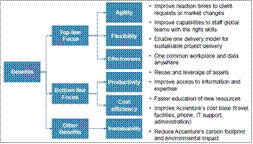
Accenture is working on more sophisticated ways to bring social media into the workplace and recent trends in social media and mobile technology have created new challenges and forced Accenture to reevaluate the IT infrastructure it has in place. Accenture has also focused on measurement strategy and on understanding what tools employees were using, and how and why they were using them. Monthly Collaboration 2.0 scorecard and other reports help Accenture continuously track usage, cost savings, employee satisfaction and impact on the clients. According to company website, cost benefits for the company included More than 20 million minutes of company-standard monthly VoIP audio/video usage, resulting in avoided mobile and landline long distance/international voice costs, more than 5,000 annual video conferencing meetings resulting in avoided travel costs and Telepresence usage has slashed travel costs and the savings are exceeding the annual targets, thus far returning more than two times the monthly operating cost.

According to Accenture, they even made these tools available to their FORTUNE 500 clients, bringing clients into their collaborative culture. Links between Accenture and client companies include Telepresence, desktop audio and video, secure IM, desktop-sharing and unified messaging that dramatically improves dialogue with clients. Collaboration 2.0 has significantly improved client satisfaction levels and clients are being services well with right skilled consultants at right time for the critical projects and reaction time to client’s requests have also improved. Employees too are satisfied with this collaboration suite as they are able to collaborate seamlessly with their colleagues across the globe, share their knowledge, interact with SMEs and voice their opinions regarding the company policies and strategies. Accenture is one of the best examples for understanding the business impact of integrating social media tools into the organization.

Discussion points:
  1. What are the key lessons of the Accenture Social Media Strategy and how it improved profitability?
  2. What is the role played by Collaboration 2.0 in improving the employee satisfaction and how to encourage employees to utilize this best?
  3. How did clients of Accenture profit from its internal social media tools?
  4. What is the role played by social media tools in organizational Knowledge management strategy?
Appendix:
Figure 1: Collaboration benefits outlined in Accenture's business case. Copyright 2010 Accenture