Thursday, December 8, 2011

Social Media 2011 and Future Growth – Summary of Gartner Research


Worldwide social media revenue is on track to reach $10.3 billion in 2011, a 41.4 percent increase from 2010 revenue of $7.3 billion, according to Gartner, Inc. and social media revenue is forecast for consistent growth with 2012 revenue totaling $14.9 billion, and the market is projected to reach $29.1 billion in 2015. Social media advertising revenue is forecast to total $5.5 billion in 2011, and grow to $8.2 billion in 2012. Advertising revenue includes display advertising and digital video commercials on any device including PCs, mobile and media tablets. Social gaming revenue is on pace to reach $3.2 billion in 2011 and grow to $4.5 billion in 2012. Social gaming includes revenue that social networking sites earn directly from users who play games that are developed in-house, and the revenue earned by allowing game developers/publishers to use their sites as a platform to let users play with friends on the network. It includes revenue earned from "virtual wallets" within games (such as when users spend virtual money on in-game items like swords or tanks, or to create virtual armies).

Social media subscription revenue is forecast to reach $236 million in 2011 and total $313 million in 2012. Few social sites charge subscription revenue, mostly for premium services. Some professional sites such as LinkedIn, Xing in Germany and Vladeo in France, charge a subscription fee from their users for enhanced services, such as an expanded profile view. The worldwide social customer relationship management (CRM) market is forecast to reach over $1 billion in revenue by year-end 2012, up from approximately $625 million in 2010, according to Gartner, Inc. Worldwide social CRM is projected to total $820 million in 2011.

By 2015, companies will generate 50 percent of Web sales via their social presence and mobile applications, according to Gartner, Inc. Vendors in the e-commerce market will begin to offer new context-aware, mobile-based application capabilities that can be accessed via a browser or installed as an application on a phone. Gartner predicts that by 2013, 80 percent of North American and European online sellers will expand into Brazil, Russia, India, Africa, Japan or China. Organizations based in North America and Western Europe is already launching website-based sales operations in new countries, in the hope of expanding to new markets.

There are signs of maturity in the social media market, as some users in certain segments are showing “social media fatigue”, according to a survey by Gartner, Inc. Gartner surveyed 6,295 respondents, between the ages of 13 and 74, in 11 developed and developing markets in December 2010 and January 2011. Of the respondents, 24 percent said they use their favorite social media site less than when they first signed up. These respondents tended to be in segments that have a more practical view of technology. But 37 percent of respondents, particularly those in younger age groups and more tech-savvy segments, said they were using their favorite site more. 33 percent said they were concerned about online privacy. Attitudes to privacy were also age-related; with teenagers citing privacy concerns significantly less often than older respondents (22 percent of teenagers agreed or strongly agreed that privacy concerns were decreasing their enthusiasm, against an average of 33 percent).

From a geographical point of view, some of the more mature social media markets — Japan, the UK and the US — corresponded to the global average trend — with roughly 40 percent of respondents using the site more than when they first started, 40 percent using it the same amount, and 20 percent using it less. Markets where enthusiasm was higher included South Korea and Italy, where nearly 50 percent of respondents said they used their social media sites more. At the other end of the spectrum, countries with the most respondents saying they used the site less included Brazil and Russia — both with between 30 and 40 percent of respondents exhibiting less enthusiasm.

During the next two years, 30 percent of leading companies will extend the goals of their online community activities to the design of enhanced service processes, such as social CRM, according to Gartner, Inc. Social CRM for customer service has only recently entered into the realm of contact center infrastructure and customer service software components, where it has been met with significant hype despite a limited number of field deployments," said Drew Kraus, research vice president at Gartner. "In 2010, only 5 percent of organizations took advantage of social/collaborative customer action to improve service processes; however, customer demand and heightened business awareness is making this a top issue among customer service managers," Mr. Kraus said. "At current trajectories, within five years we expect that community peer-to-peer support projects will supplement or replace Tier 1 contact center support in more than 40 percent of top 1,000 companies with a contact center."

Many social media efforts are failing, because some enterprises just don't understand how to employ social media to facilitate collective behaviors, according to Gartner, Inc. Gartner conducted a 10 month effort collecting data and analyzing 200 successful social media implementations to identify how enabling collective human behaviors can lead to enterprise value. Enterprises that understand the importance of harnessing the power of collective behaviors to drive positive business change will be the ultimate winners with social media," concluded Anthony Bradley, group vice president at Gartner. Gartner believes that examining key selected behaviors provides critical insight into how social media can deliver significant enterprise value. The six collective behaviors include: Enable Collective Intelligence for Operational Effectiveness, Employ Expertise Location for Sales Effectiveness, Unearth Emergent Structures for Operational Effectiveness, Increase Sales through Interest Cultivation, and Engage in Mass Coordination for Rapid Response, Build Relationship Leverage for Brand Awareness.

Source: Gartner 2011 Press releases 

Social Media @ HP – WaterCooler deployed internally


HP’s culture famously known as the “HP Way” focused on innovation, integrity and collaboration, which was a natural match for social media. HP followed the policy of management by walking around which allowed employees share experiences, learn from one another in office, and employees developed their careers through discovery and learning from peers. HP has changed over decades and with the changing technology and emergence of Web 2.0, HP also embraced these technologies and provided various platforms for their employees. HP currently have over 300,000 employees and have more than 350 social media communities, blogging and social media activity has increased by 10 times, and the referrals from social networking sites doubled and company has benefited remarkably due to employees conversing directly with the customers.

HP had been encouraging its employees to blog and they can participate in group or individual blogs on company specific business topics and other topics ranging from photography, personal hobbies, about employee families, IT management to innovation. All the blogs are linked to company website and through blogging HP audiences could join communities with different interests and allowed HP to personalize their brand and connect directly with stakeholders. HP provides requisite training to employees that will represent the company on a social network and employees are provided with guidelines and have a well defined, publicly available, blogging policy. They even have a digital media council, which includes representatives from all business units, that sets the policy for how HP will participate in social networks. HP intranet @hp launched 2006 was another initiative which was a one-stop access to everything from personalized portal access to HR tools and forms, online purchasing, collaborative tools, podcasts and webcasts, and a special ‘newsgram’ Cheater that automatically summarized description of the stories published in a given week and distributed to all HP employees.

WaterCooler is a tool developed by the HP Social Computing Lab in 2007, and deployed within HP and it started as aggregator of RSS feeds from across the company and as time passed by turned into a social media aggregation platform that aggregates content from HP’s internal wikis, microblogs, various discussion forums, and social bookmarks. The system is integrated with HP’s user directories and has a documented set of open APIs and supports a powerful and expressive set of content filters across different social media systems. Tags provide the basis for public profiles of people in WaterCooler allowing anyone to apply a tag to anyone else and allow users to support distributed teams that span business units.According to HP, 61% of users in a recent survey reveal WaterCooler changed their perception of collaboration at HP while others say it makes the company feel more personal.

HP Social Computing labs have developed WaterCooler and with more than 100,000 employees using this tool, plans are there for selling this tool to their clients. Research areas of the Labs are unique like using social media to predict future, influence & passivity, etc. HP is also empowering its employees to communicate and collaborate, using social media, with fellow employees and other stakeholders to create and innovate market changing solutions.


Saturday, December 3, 2011

Social Media @Accenture Case study – Accenture Collaboration 2.0


Social media has changed the way employees in organizations work, learn, communicate and collaborate. According to Accenture, companies that invested early to harness the power of social media claim returns as high as 20 to 1, with even greater gains predicted to be on the way and the reality is that its impact will be felt along the entire length of the value chain. Employees, who are also users of public social media sites, were looking for tools to increase their productivity through collaboration across globally dispersed workforce. Collaboration 2.0 is a suite of tools that include blogs, wikis, and youtube, facebook style social media tools that employees can use to do their jobs in a better way and strengthen client relationships. Through these tools 236,000 employees of Accenture located in 120 countries collaborate for organizational growth and Collaboration 2.0 improved team productivity, reduced travel and phone charges via a new world of virtual collaboration and strengthened client relationships. In 2008 Accenture launched collaboration initiative called “Borderless Workplace” which includes technologies a wiki called Accenture Encyclopedia, Accenture media exchange resembling YouTube, personal blogs for employees and a facebook inspired social network called Accenture people, Accenture’s Knowledge Exchange is the place to go to find the information Accenture people need.

Accenture deployed in 2007, Accenture People that is a Facebook-inspired professional/social network that enables employees to collaborate, share knowledge, find SMEs and instantly connect via email, online chat, whiteboard session, high definition telepresence videoconference, phone or voicemail. Each profile is populated with standard company information and Accenture employees are encouraged to expand their profiles and 115,000 employees have updated their profiles and 5000 profiles update every month where employees share pictures, bios, expertise, work-related interests personal interests, hobbies and other optional personal information.

According to Accenture, as employees share more about themselves on their profiles, the connections for prospective teams and colleagues become richer. From a profile, an employee can get to know coworkers, their reporting relationships and experience. Employees can use a colleague-tracker to receive alerts when associates change information on their profile – such as their skills or clients. Company also developed a Wikipedia-style site called Accenture Encyclopedia, to catalogue Accenture business and technical terminology. Close to 1000 entries posted in this encyclopedia.

More than 1,700 Accenture Groups, communities created and run by Accenture employees which enable them to share knowledge beyond their job responsibilities. Group topics span from Java programming to Lean Six Sigma to digital photography. These groups focus on an individual’s needs and interests, as well as the needs of the communities. For microblogging Accenture uses Yammer where teams can securely and quickly connect, Twitter-style, to trade ideas and get the best thinking from their global colleagues. Presently employees post more than 4200 microblog updates monthly.

Blogging capabilities amplify opportunities for sharing experience and expertise. Accenture employees created 10,706 blogs annually, increasing at a rate of more than 200 percent annually. Presently employees post 1000 blog posts a month. Blogs are an informal communications across Accenture as employees recognize the value and power of blogs that can be easily aggregated and tagged. Employees can use this space to post comments on strategies under development, answers to frequently asked questions, etc. Blogs feature thought leadership on a wide range of business issues, with a particular focus on helping companies achieve high performance and also discuss about emerging technologies and career experiences of select employees.

Accenture Media Exchange is a You-Tube-type tool that included videos related to training, marketing, knowledge transition and community-building videos circulating among employees. Currently 12,000 video items posted to Accenture Media Exchange. Videos posted include included executive interviews, project team presentations, and humorous snippets, and came from users around the world. Video content posted on the site typically is viewed by hundreds or even thousands of colleagues within a few days. Viewers can rate and comment on the posted content as well as download material useful for other applications.

According to Accenture, the knowledge base of Accenture’s employees is a massive resource and a critical asset and includes discussion forums, blogs, wikis and even ratings, comments, cross-search downloads and recommendation functionality. The existing knowledge repository, called Knowledge Exchange, was migrated to global Microsoft platform and consolidated its knowledge assets into a central repository based on Microsoft SharePoint Portal Server. The development of a new Knowledge Exchange application enabled Accenture to retire over 40 databases and offer a single point of access through the Accenture Portal (the company’s employee portal). Accenture's use of NewsGator as a micro-blogging tool in the Microsoft SharePoint platform brings a geographically dispersed workforce together to meet clients' needs.

Consolidating the knowledge assets resulted in the enterprise search engine to index the content thoroughly and with a consistent taxonomy applied and IT team was able to fully index the actual content of all documents so searches would yield more relevant results. Now, Accenture employees can search a broader range of knowledge assets from a single point of access, or search deeply within an attachment. Today, the search engine indexes approximately 115,000 attachments and topic pages in the Knowledge Exchange. Accenture-wide, employees can also search across almost four million pages or attachments from 46 different Accenture content sources, enabling efficient searches that yield highly relevant results. Accenture Knowledge Exchange Activity Feeds includes RSS-like activity feeds to notify employees when articles are published, capture project status updates, display tasks and suggest related documents.

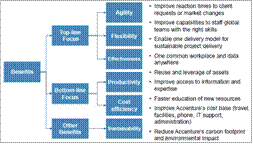
Accenture is working on more sophisticated ways to bring social media into the workplace and recent trends in social media and mobile technology have created new challenges and forced Accenture to reevaluate the IT infrastructure it has in place. Accenture has also focused on measurement strategy and on understanding what tools employees were using, and how and why they were using them. Monthly Collaboration 2.0 scorecard and other reports help Accenture continuously track usage, cost savings, employee satisfaction and impact on the clients. According to company website, cost benefits for the company included More than 20 million minutes of company-standard monthly VoIP audio/video usage, resulting in avoided mobile and landline long distance/international voice costs, more than 5,000 annual video conferencing meetings resulting in avoided travel costs and Telepresence usage has slashed travel costs and the savings are exceeding the annual targets, thus far returning more than two times the monthly operating cost.

According to Accenture, they even made these tools available to their FORTUNE 500 clients, bringing clients into their collaborative culture. Links between Accenture and client companies include Telepresence, desktop audio and video, secure IM, desktop-sharing and unified messaging that dramatically improves dialogue with clients. Collaboration 2.0 has significantly improved client satisfaction levels and clients are being services well with right skilled consultants at right time for the critical projects and reaction time to client’s requests have also improved. Employees too are satisfied with this collaboration suite as they are able to collaborate seamlessly with their colleagues across the globe, share their knowledge, interact with SMEs and voice their opinions regarding the company policies and strategies. Accenture is one of the best examples for understanding the business impact of integrating social media tools into the organization.

Discussion points:
  1. What are the key lessons of the Accenture Social Media Strategy and how it improved profitability?
  2. What is the role played by Collaboration 2.0 in improving the employee satisfaction and how to encourage employees to utilize this best?
  3. How did clients of Accenture profit from its internal social media tools?
  4. What is the role played by social media tools in organizational Knowledge management strategy?
Appendix:
Figure 1: Collaboration benefits outlined in Accenture's business case. Copyright 2010 Accenture